
0%
Loading ...
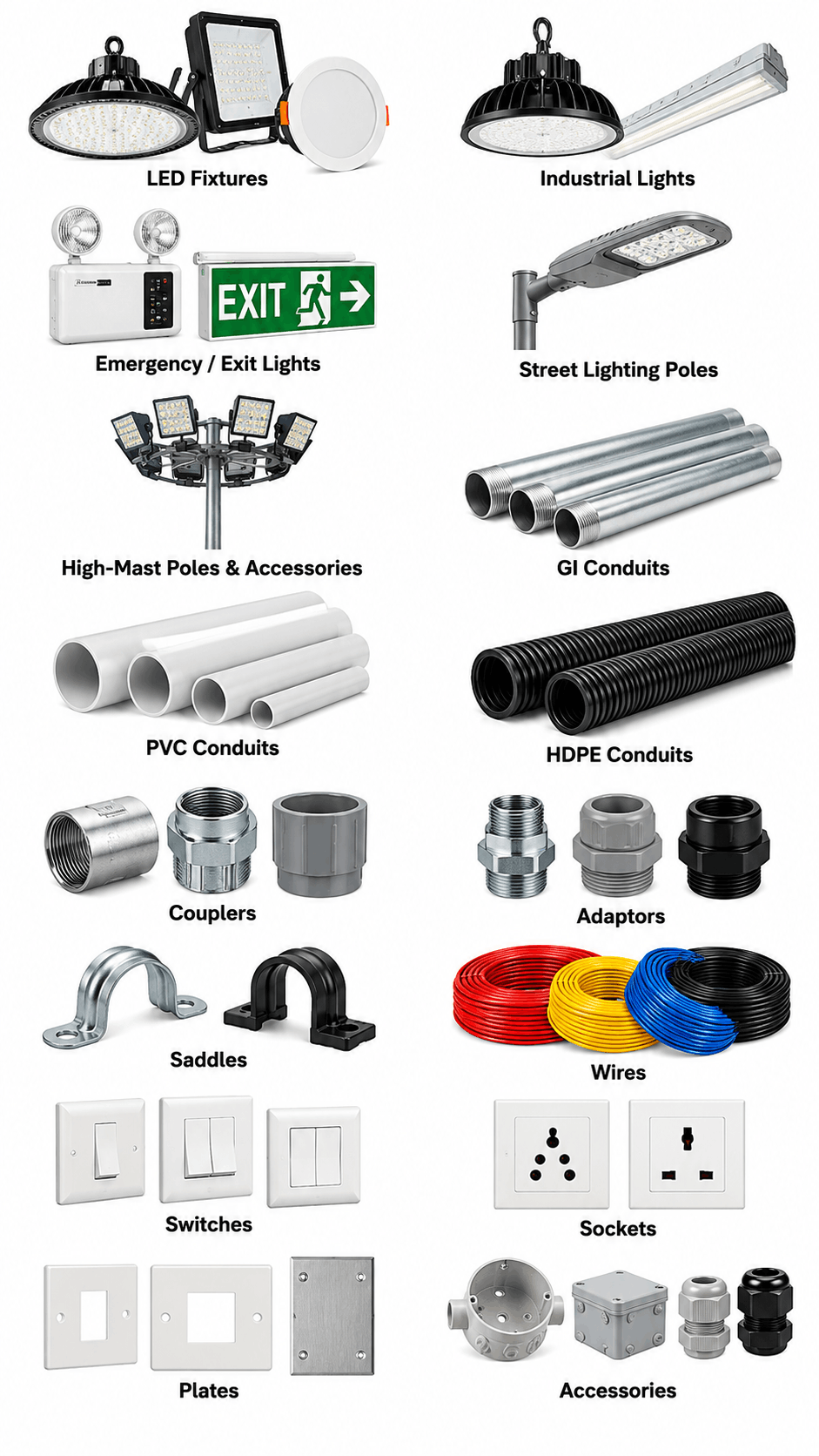
LED fixtures are used to provide efficient and controlled illumination across commercial buildings, offices, industries, warehouses and public spaces. They support general, task and area lighting while offering suitable solutions for indoor and outdoor electrical lighting installations.
Industrial lights are used to illuminate factories, warehouses, workshops, production areas and other demanding work environments. They provide suitable visibility for operational activities, equipment handling and safety while supporting various high-bay, low-bay and industrial lighting applications.
Emergency and exit lights are used to provide illumination and clearly identify escape routes during power failures or emergency situations. They support safe evacuation by maintaining essential visibility in commercial buildings, industries, offices, hospitals and public facilities.
Street lighting poles are used to support and position outdoor lighting fixtures along roads, streets, pathways, parking areas and public spaces. They provide suitable mounting structures for street lights while supporting organized and effective outdoor area illumination.
High-mast poles are used to mount multiple high-intensity lighting fixtures at elevated heights for illuminating large open areas. They are commonly installed in highways, ports, airports, stadiums, industrial facilities, logistics yards and large parking areas.
GI, PVC and HDPE conduits are used to route and protect electrical wires and cables from mechanical damage, moisture and environmental exposure. They support organized wiring installations across buildings, industrial facilities, infrastructure projects and outdoor electrical applications.
Electrical conduit couplers are used to join two conduit sections securely and maintain continuous cable protection along a wiring route. They support extensions and connections between conduit lengths while helping maintain organized and protected electrical installations.
Conduit adaptors are used to connect conduits with electrical boxes, panels, fittings or equipment having different connection arrangements. They provide secure transitions between components and support flexible, organized and protected cable routing within electrical installations.
Conduit saddles are used to secure electrical conduits firmly against walls, ceilings and other mounting surfaces. They maintain proper conduit alignment, provide mechanical support and help create neat and organized wiring installations across buildings and facilities.
Electrical wires are used to carry electrical current between power sources, distribution equipment, switches, sockets, lighting fixtures and connected loads. They support electrical wiring and circuit connections in residential, commercial, industrial and infrastructure installations.
Electrical switches are used to control the flow of electricity to lighting fixtures and connected electrical loads. They provide convenient manual operation and circuit control across residential, commercial, office, industrial and other building electrical installations.
Electrical sockets provide connection points for plugging electrical equipment and appliances into a power supply. They are commonly installed in residential, commercial, office, industrial and institutional buildings to provide convenient access to electrical power.
Electrical plates are used to provide a finished mounting and covering surface around switches, sockets and other wiring accessories. They improve installation appearance while protecting and securely positioning electrical devices within walls and electrical mounting boxes.
Electrical accessories include supporting components used for wiring, conduit installation, cable connections and electrical device mounting. They help complete electrical installations by providing practical connection, protection, fixing and finishing solutions for various building and industrial applications.